All about New Mills and Thornsett
In Batemill Cottage you can consider yourself to be on the outskirts of New Mills or on the outskirts of Thornsett, according to mood.
New Mills really is quite new: it emerged only in the late 18th century, as an industrial village for cotton textiles. As late as 1824, maps of the area don’t show it at all. On the other hand, the name ‘New Mills’ seems to be much older: from the 14th century there was a hamlet clustered around a manorial corn mill, ’the New Mylne’, in a loop of the river Sett, near what is now Salem Mill at the bottom of what later became New Mills’s ‘High Street’. There is an ancient bridge crossing there too, across the river Sett, just upstream of the impressive but formidable river gorge ’the Torrs’.
Thornsett by contrast, though tiny, is ancient, first mentioned in 1086 in the Domesday Book: there you can read of an Anglo-Saxon thane called Ligulf whose land in “Tornesete” (‘a settlement among thorns’) was nabbed by King William I - the earliest record of any place name near what’s now New Mills. By the 13th century, the area now called New Mills was part of the royal forest of the Peak, which covered much of north-west Derbyshire; the ‘Rolls of the Forest of the Peak’ mentions Adam, the son of the chaplain of Thornsett in the mid 13th century, so perhaps there was a medieval chapel here?
Peering even further back, the Romans had a Spa at Buxton and a fort at Glossop; their road linking the two would logically have followed the course of Hayfield road.
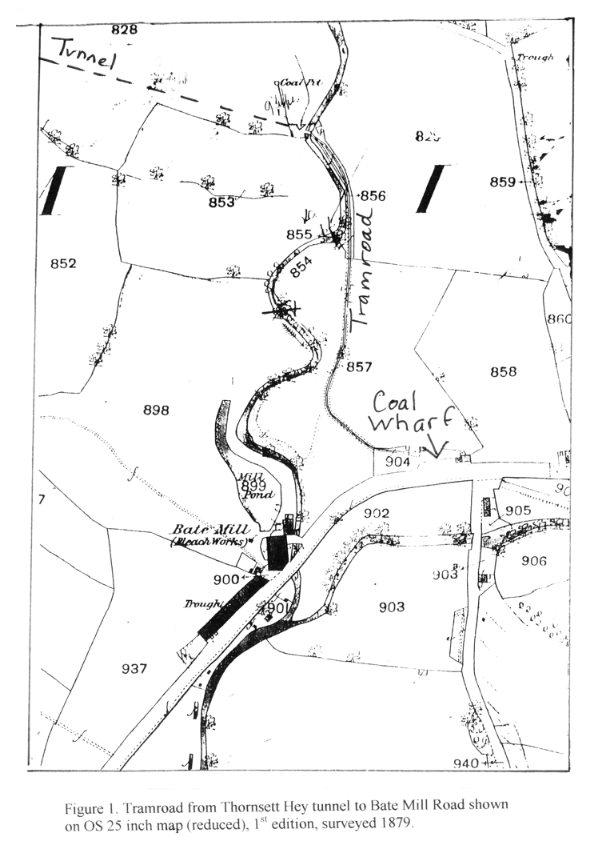
After removal of the deer from the royal forest and relaxation of the forest law in the 17th century, a period of new prosperity is shown by the growth of farms (like the 16th/17th century Thornsett Hay Farmhouse a hundred yards from Batemill cottage, next to the Printer’s Arms), coal mines, tracks and roads, all with names recognisable on a map today. Coal was mined on the upper moorlands in the 18th century and, with increased demand in the 19th century, continued lower down in deeper mines. There was even a coal wharf on Batemill road, just the other side of the Bate Mill, on the end of a tramway leading up to a coal mine north of Thornsett. In this period the pennine landscape all around here was dotted with bits of small-scale mining infrastructure like this - mostly now disappeared since better quality coal started to be imported from Yorkshire.
A Milling Town
In the late 18th century more and more mills were built in the Torrs on the banks of the rushing rivers Sett and Goyt (now with water power, mechanisation, and the factory system for cotton). The Torrs were especially suitable for mill-building: rocky waterfalls and cascades allowed the construction of weirs; there were good building sites on rocky terraces just above river bends; and of course there was plenty of building sandstone. 31 Batemill Road (‘Crowden Cottage’) dates from this period.
A town grew up quite quickly, spreading up what is now the sloping and surprisingly diminutive ‘High Street’ and over the fields of the Torr Top estate. A population of 1,878 in 1801 had almost doubled by 1831. The row of cottages on Batemill Road are clearly marked on an 1830 map, as is the Bate Mill itself, which was a bleach works, for bleaching cotton, whose historical origins are unclear. (Incidentally the Bate Mill now houses Settvale Plumbing and Heating Merchants, the sort of shop into which you shouldn’t allow the middle-aged man-in-your-life without a strict return deadline.)
All this building, the construction of turnpike roads, the Peak Forest Canal and railways (with sidings and goods sheds), huge viaducts over the Torrs, the new church and parish, schools and chapels, a public hall (later the town hall), the introduction of steam power, growth of the calico printing and engraving industries, and the rise of a new industrial suburb, Newtown - all this took place without an urban authority. It was not until January 1876 that a municipal authority, the New Mills Urban Sanitary Authority, first met. Compare this with, say, Bakewell (Market Charter granted 1203), Glossop (Market Charter 1290) and Stockport (even posher Borough Charter, and hence a Mayor and corporation, around 1220).
Since many houses in New Mills were built on steeply sloping ground, houses of two storeys on one side often have three or four on the other: sometimes one household occupies the upper half, while another occupies the ‘underliving’ in the lower half.
Church matters
There would probably never have been a town of New Mills had there not been a Church of England Parish created here. The new parish of New Mills was formed as late as 1844: St George’s church had recently been opened in 1831. (St George’s was a ‘commissioner’s church, meaning that it was paid for by the British government, which suddenly felt flush in the 1820s when Austria unexpectedly paid off a £2 million war loan that Britain had already written off.) This area had previously been part of the parish of Glossop, ancient but un-manageably huge and hilly, and the new parish was carved out from part of a ten-hamlet administrative area, known since the sixteenth century as Bowden Middlecale, which had included Hayfield, Whitle, Thornsett, Ollerset, Mellor and Chinley.
But by this 1844 date, Wesleyan non-conformism had well and truly beaten the established Church to New Mills: the first Methodist chapel had been on the High Street since 1766 (and would have been much bigger had there been anywhere sufficiently flat to expand it into!). This chapel was frequented by many of the mill owners, and was regularly visited by John Wesley himself. There must be few English towns where the Anglican Parish Church is so far from the town centre and so far up the ‘wrong’ side of a steep river gorge; the trek for any ’non-Chapel’ folk through the rain to Matins, back home for lunch and then back again for Evensong every Sunday must have been unenviable.
At the time of its creation the new parish would have been in the diocese of Lichfield, but it got pinged across to the diocese of Southwell when that was created in 1884. The diocese of Derby was split from Southwell in 1927 and naturally New Mills came with it.
The Torrs
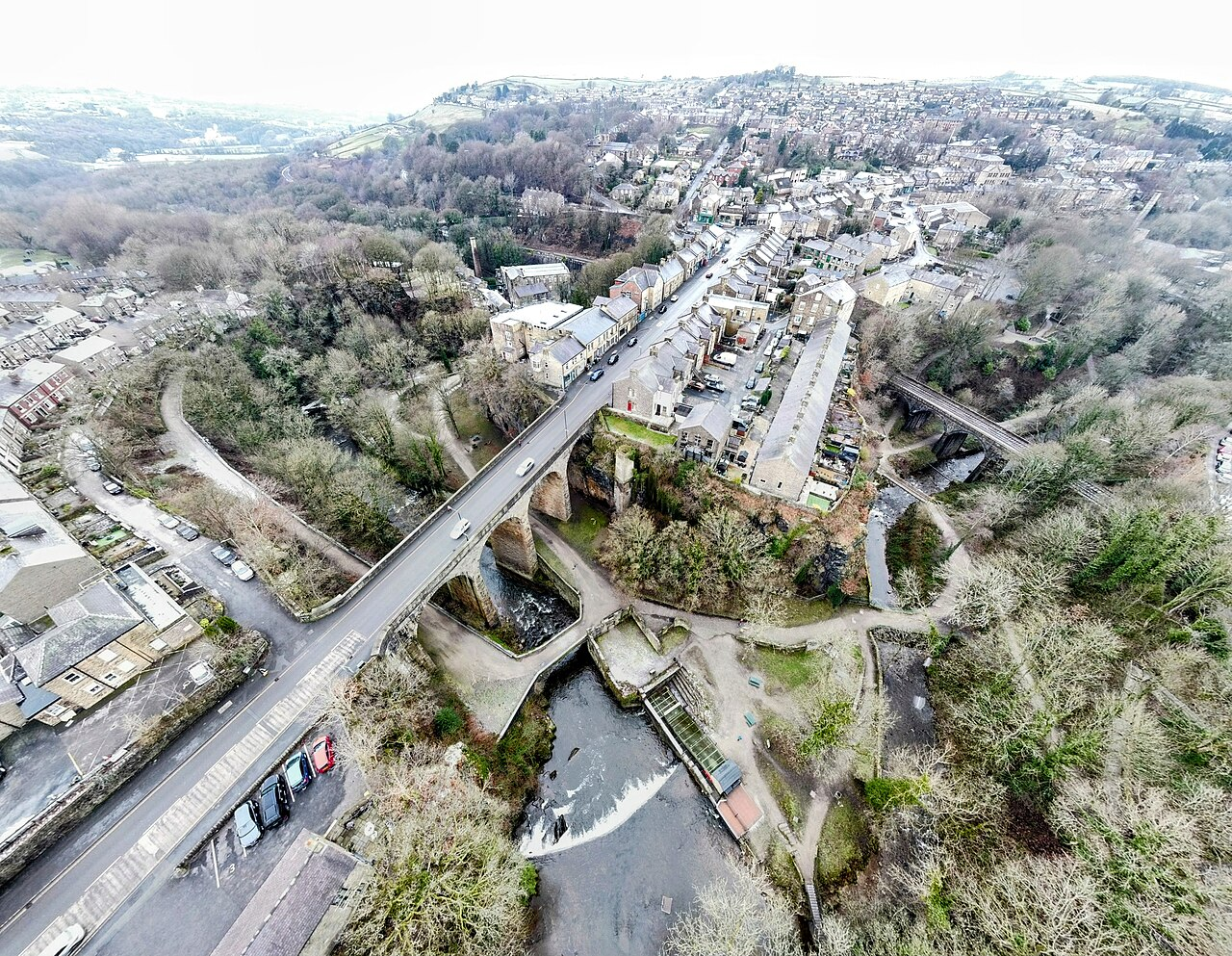
This town, then, has two personalities: one which looks up to the breathtaking pennine scenery of the high peaks which surround it, and the other which peers down into the depths of the Torrs gorge, formed by melting ice after the last Ice Age 20,000 years ago, and up to 30m deep. If you start at the Heritage Centre in Rock Mill Lane you can walk down (51 steps) and discover the many natural and man-made features of the Torrs. Towering rock faces (popular for rock-climbing), majestic trees, and bird life mingle with mill ruins, roaring weirs, enormous stone arched viaducts and bridges, railways, the instagram-honeypot Millennium Walkway and even a community-run hydro-electric power scheme. Wheelchair access to the Torrs is from the bottom of Station Road and from Wirksmoor Road (opposite the Rock Tavern).
Though the Torrs’ riversides were sought after for industrial-age water mills, for centuries the steep and rocky descent to the river was a barrier to development and communication. Despite the bustle of industry, the mills lacked easy access for goods and vehicles. Brake horses were needed to steady the descent of wagons carrying supplies. The ancient New Mills Bridge (Salem Bridge) was inconveniently upstream of the gorge, while the two low-level bridges down in the Torrs could only be reached between steep road descents and ascents.
The building of Church Road Bridge (1835) and the monumental striding viaduct of Union Road Bridge (1884) united New Mills by road for the first time with Newtown, Disley, Furness Vale and Marple, and so with Stockport and Manchester (and for 21st century cars, with the road now signed as the A6). Tunnels and bridges enabled two railway lines to cross the Torrs, one to Hayfield (closed in 1970 and now redeveloped as the Sett Valley Trail) and one to Derby (now used by the Manchester / Sheffield service).
The river Goyt joins the river Tame at Stockport to form the river Mersey. Since the Goyt is a fraction longer than the Tame (30 1/2 miles vs 29 1/2), opinion hereabouts leans towards the conclusion that the Mersey should be called the Goyt. Liverpudlian opinion is not typically sought on this matter.
The ‘Park under the Town’
Bankruptcy, fire, and continuing poor access all contributed to industrial and environmental decline in the Torrs and in New Mills from the late 19th century. Abandoned for 50 years, its mills in ruins and used as a rubbish dump, the Torrs became dangerous to the public. This period must be reckoned as the nadir of New Mills’s history (and lingering lazy prejudice from it is the reason why New Mills still sometimes gets bafflingly added to ‘worst places to live’ lists!). Only in the 1970s was the value of the gorge’s outstanding beauty meaningfully recognised. On the initiative of a town council committee led by Dr Leslie Millward, the area was cleaned up and officially ‘re-opened’ in 1974.
Thankfully these improvements continued, and the Torrs gorge is now our ‘Park under the Town’. The sandstone cliffs offer a range of challenges for rock climbers. A wide variety of birdlife has returned, including dipper, heron, and kingfisher, and the gorge is rich in trees (ash and sycamore, mixed with oak, alder and willow). Wildlife corridors lead from the gorge into established nature reserves downstream at Mousley Bottom and upstream at Goytside Meadows. The eye-catchingly modern Millennium Walkway, curving between railway and river, unites the two ends of the gorge for the first time, and completes the final link in the 230-mile Midshires Way, one of the country’s central walking routes which runs from Stockport to the Chilterns in Buckinghamshire. At the confluence of the Sett and the Goyt, a reverse Archimedes screw (‘Archie’) harnesses clean water power to generate a surprisingly substantial amount of electricity for local use - it powers the big Co-op, plus a bit - and so the 21st century carries forward the industrial heritage left by the 19th.
The loveliest way to get to the Torrs from Batemill Road is along the Sett Valley Trail, the route of the dismantled railway from New Mills to Hayfield. The loveliest way to get back is over the top along Spring Bank, with its panorama of Kinder Scout, Lantern Pike and Chinley Churn.
The Peak Forest Canal
Limestone from quarries on top of the peaks (especially at Dove Holes) needed to be transported downhill to Manchester and so from 1796 onward the Peak Forest canal was dug. As it passes New Mills it takes advantage of the more leisurely contours of the far side of the Goytside valley after the river has emerged from the gorge, threading through Newtown and Furness Vale and terminating in Bugsworth Basin. The original plan was to continue it all the way up to Dove Holes, but the climb would have needed many locks and to cut costs the final stretch was done via a tramway. Like most British canals it fell out of use after the railways were built, and was derelict and largely unnavigable until its restoration and re-opening in 1974 (with Bugsworth Basin having to wait until 2003 for restoration). It’s great for a flat but scenic walk or bike ride (though ‘flat’ is always something of a relative term in this area) - via the Sett Valley Trail, the Torrs and the Goytside Meadows, for kayaking or paddle-boarding, and you can hire a day boat from New Mills marina - https://www.abcdayboathire.com/locations/new-mills-marina/.
In case you’re wondering, the huge mill with the very tall tower in Newtown next to the canal near the marina is the Swizzles factory (strictly ‘Swizzles Matlow Ltd’), where millions and millions of sweets including Love Hearts, Parma Violets, Drumstick lollies, Refreshers, Double Dip and Squishies are made. The Matlow company moved to New Mills temporarily from London during the Blitz in 1940 and never went back. It’s a major local employer, and kids go weak at the knees from the syrupy smell near the canal when they’ve got a batch brewing!
The Kinder Trespass
New Mills has a direct role in making Britain a paradise for hikers. Until 1932 huge areas of the high peaks were privately-owned grouse shooting estates; the public was barred from most of the uplands. On the back of a growing resentment against this, on 23 April 1932 around 400 young ramblers mostly from Manchester and Sheffield set off to Kinder Scout - the highest point in the peak at 636m and only a couple of miles from Batemill Road - in defiance of their rights of way. Scuffles broke out with the Duke of Devonshire’s gamekeepers and one keeper was injured. Police arrested six men and they were detained in the New Mills police station on Hall Street. Subsequent prison sentences for these detainees caused a national outcry which eventually led to the National Parks and Access to the Countryside Act (1949) being passed, creating our national parks (of which the Peak District was the first) and formalising protection for rights of way.
The National Trust purchased the Kinder Plateau from the Duke in the 1980s, and nowadays many of the iconic uplands in the area are owned by the nation, including Lantern Pike, Mam Tor and Lose Hill.
The trespassers met at Bowden Bridge quarry just outside Hayfield and would surely have travelled by train along what is now the Sett Valley Trail to Hayfield. You can still see the police station building on Hall Street. Incidentally the river Sett was often also called the river Kinder until the Ordnance Survey maps formalised the name in 1830. You are warmly encouraged to carry out your own Kinder Trespass starting at Batemill Road!
Illustrations / sources
Acknowledgements to https://www.newmillshistory.org.uk from which much of this was adapted; please go there for more information.
It could get nerdy here …
1086 Domesday - the Thornsett Entry
https://opendomesday.org/place/SK0186/thornsett/ - there wasn’t much here though: 0 households and no recorded population for tax purposes in ‘Tornesete’, and the new Lord was to be King William I himself. Thornsett was worth £2 annually to him; compare for example with Tideswell which was worth £10 6s annually, 30 villagers (ie village families), 4 households and one priest (and Tideswell was still in the smallest 20% of settlements). ‘Heifeld’ may be a reference to Hayfield; if so things there were much the same as in Thornsett, and the same story again in Glossop. Ligulf, the pre-conquest Lord of Thornsett, had held 84 land holdings from Nottingham to Middlesborough: William left him with just six (if it’s the same person). It seems like William’s Harrying of the North hit this area hard: Stockport isn’t even mentioned!
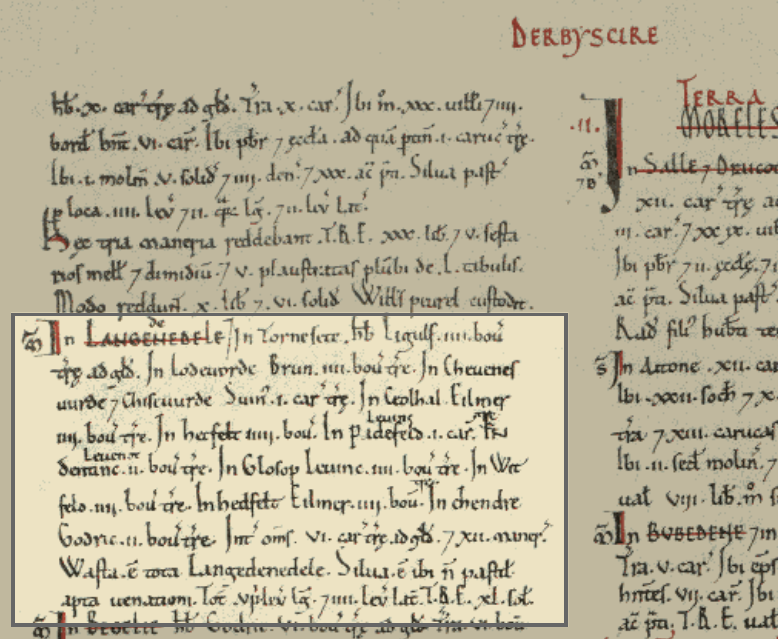
https://www.newmillshistory.org.uk/newsletters/nl05.pdf - contains a discussion of the possible medieval chapel at Thornsett.
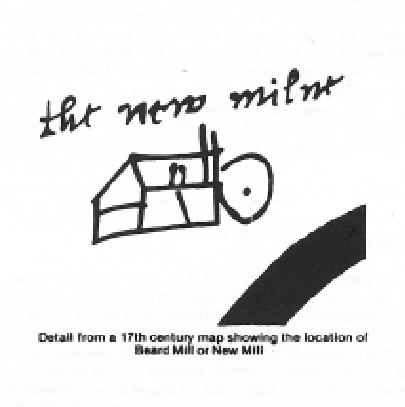
17th Century - the New Milne
https://www.newmillshistory.org.uk/newsletters/nl03.pdf - I believe this is a snip from the Hibbarte & Barton 1640 map, and that this was taken from a photocopy in NMLHS archives. I’ve not yet seen the map myself, but i understand Thornsett is also featured on it.
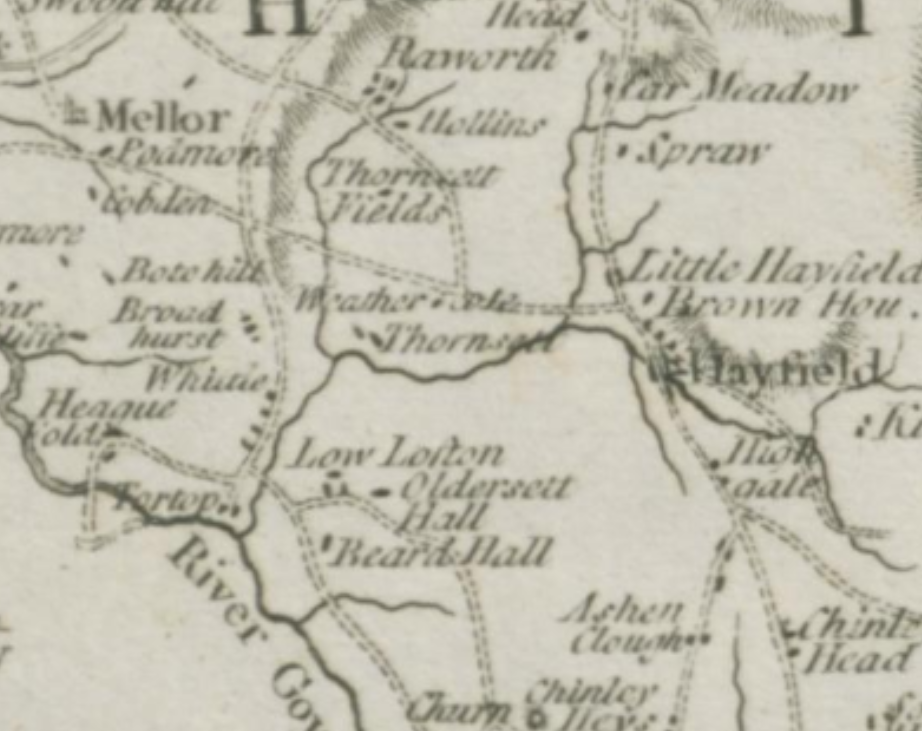
1789 - Thornsett, Whitle but no New Mills at all
From John Cary, Camden’s Brittania. Showing the river Sett and Rowarth Brook, and some housing in Thornsett and Whitle but nothing else in New Mills. The junction between the two streams is now just outside the front door of Batemill Cottage!
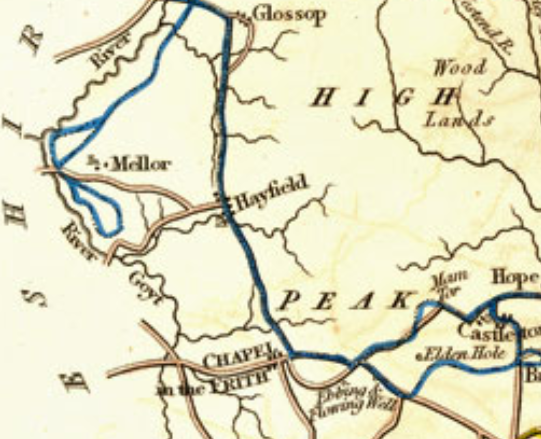
Rhodes’s 1824 Map, still no New Mills
https://www.andrewsgen.com/dby/maps/1824-rhodes.htm
Again, almost the only local feature which this map does show is the road past Batemill Cottage’s front door and the junction of the river Sett with Rowarth brook. The blue line is a later pen marking and not part of the original map; honestly, some people!
1830 - Survey of New Mills for improved water provision
https://www.newmillshistory.org.uk/waterprint.html?map=2&title=Whole%20of%20Plan
The earliest town map I’m aware of:
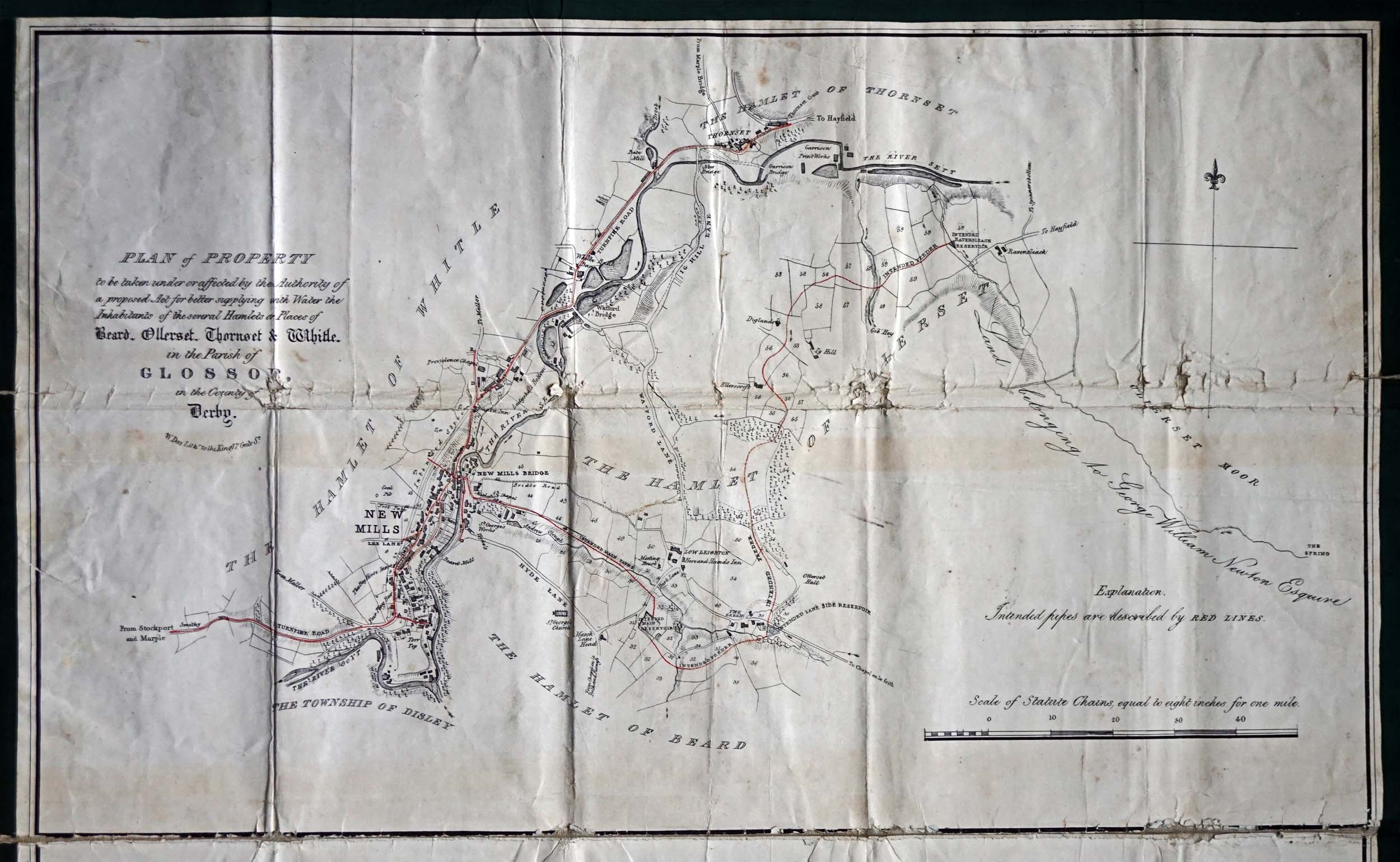
Zoomed in on the ’town’ centre - the street layout of the centre is clearly recognisable by 1830, though Torr Top is still undeveloped. The high road heading North over Spring Bank had only been built in 1820:

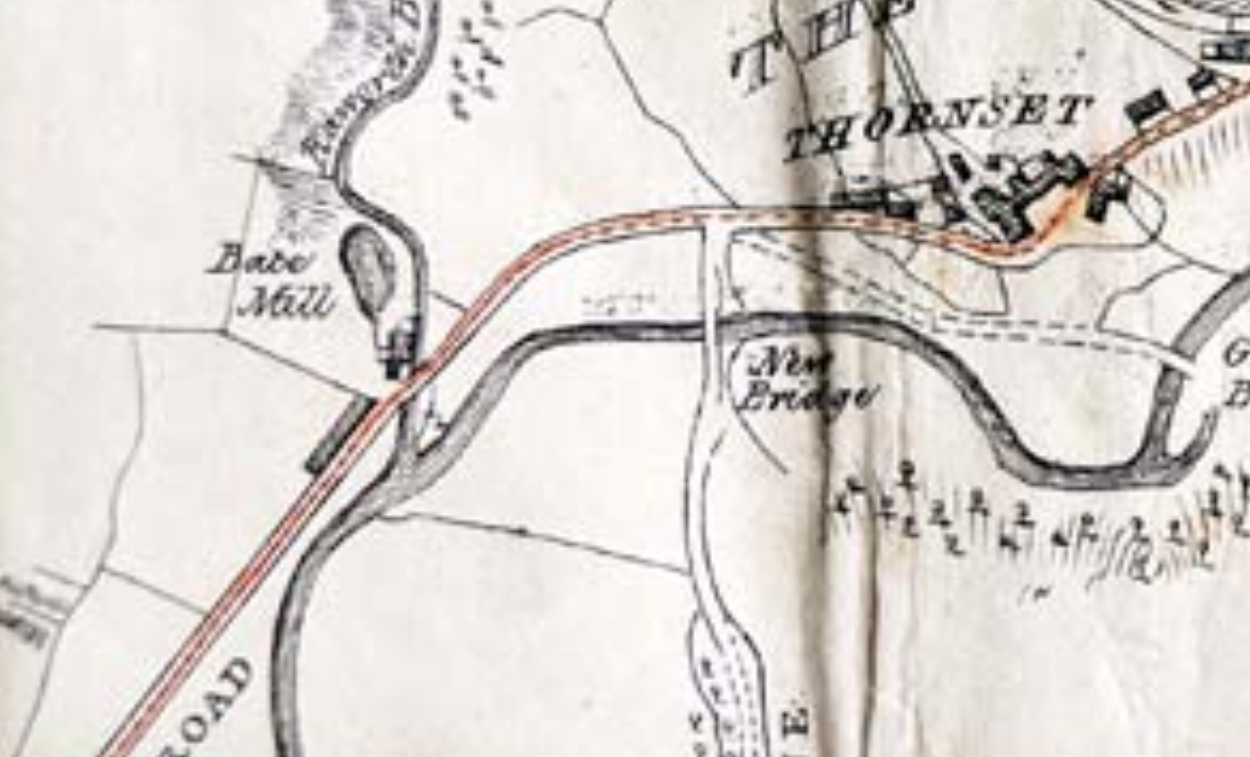
Zoomed in on Batemill Road (now marked as a Turnpike Road), showing the Bate Mill and the row of cottages was already extant by 1830:
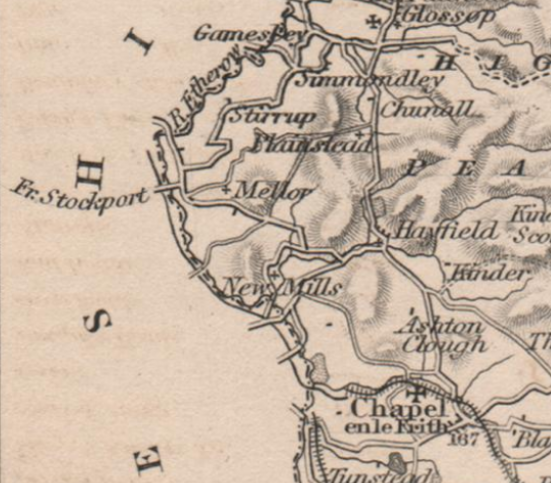
1845 - Finally New Mills merits inclusion on a county map!
https://www.antiquemapsandprints.com/products/derbyshire-county-map-by-dugdale-archer-peak-district-polling-places-1845-p-6-065235 - The 1845 Dugdale map, published the year after the New Mills CofE Parish was created.
1878 - The Coal Wharf on Batemill Road
https://www.newmillshistory.org.uk/newsletters/nl29.pdf - an 1878 plan showing the Coal Pit, Tramway and Coal Wharf a few yards up the road from Batemill Cottage
Aerial view of the Torrs
This photo is a good illustration of the multi-level tangle of bridges, paths, rivers, railways, rocks, weirs and trees which is New Mills. No wonder some people find it disorienting! Worth a quick compare with the 1830 town centre map above.
By Biguana99 - Own work, CC BY-SA 4.0, https://commons.wikimedia.org/w/index.php?curid=128365298